Abstract
Extensive research highlights nature’s positive effects
on the human body, such as stress relief and accelerated
recovery. However, less attention has been devoted to
understanding why these impacts occur. Using a
research-through-design approach, this project delves
into wearable technology as a way to explore the
human-nature connection. After broad exploration,
immersive experiences in nature helped investigate this
question. These experiences suggested that nature
fosters self-awareness by helping individuals connect
more deeply with themselves. This realization inspired
the creation of a wearable vest that mirrors this effect,
encouraging users to focus on their breathing which is a
natural mechanism central to relaxation. Crafted with
nylon threads to enhance tactile feedback, the vest
employs precisely calibrated rhythmic patterns to
promote slow, mindful breathing. By translating the
calming qualities of nature into a tangible, self-focused
experience, the design questions how to bridge the
external world of nature with the inner self of humans.
Exploration
The design process began with an exploration of our diverse interests, shaped by our interdisciplinary team.
Through iterative prototyping and testing, concepts were refined to explore how wearables can redefine the human-nature relationship. This was done in three directions: experiencing environments, wearable plants and visualising yourself.
Embodied research
First-person perspective experiments showed that touch offered the richest opportunity for a wearable interaction. We tested vibration motors on the body, explored how haptics could alter texture perception and immersed ourselves in nature. These experiences suggested that nature’s value lies partly in helping people slow down and become more aware of themselves.
Focus
Breathing became the central interaction because it provides a natural connection between attention, the body and relaxation. We developed nine vibration patterns using three motors around the lung area, varying their direction, intensity, speed and transitions.
Garment development
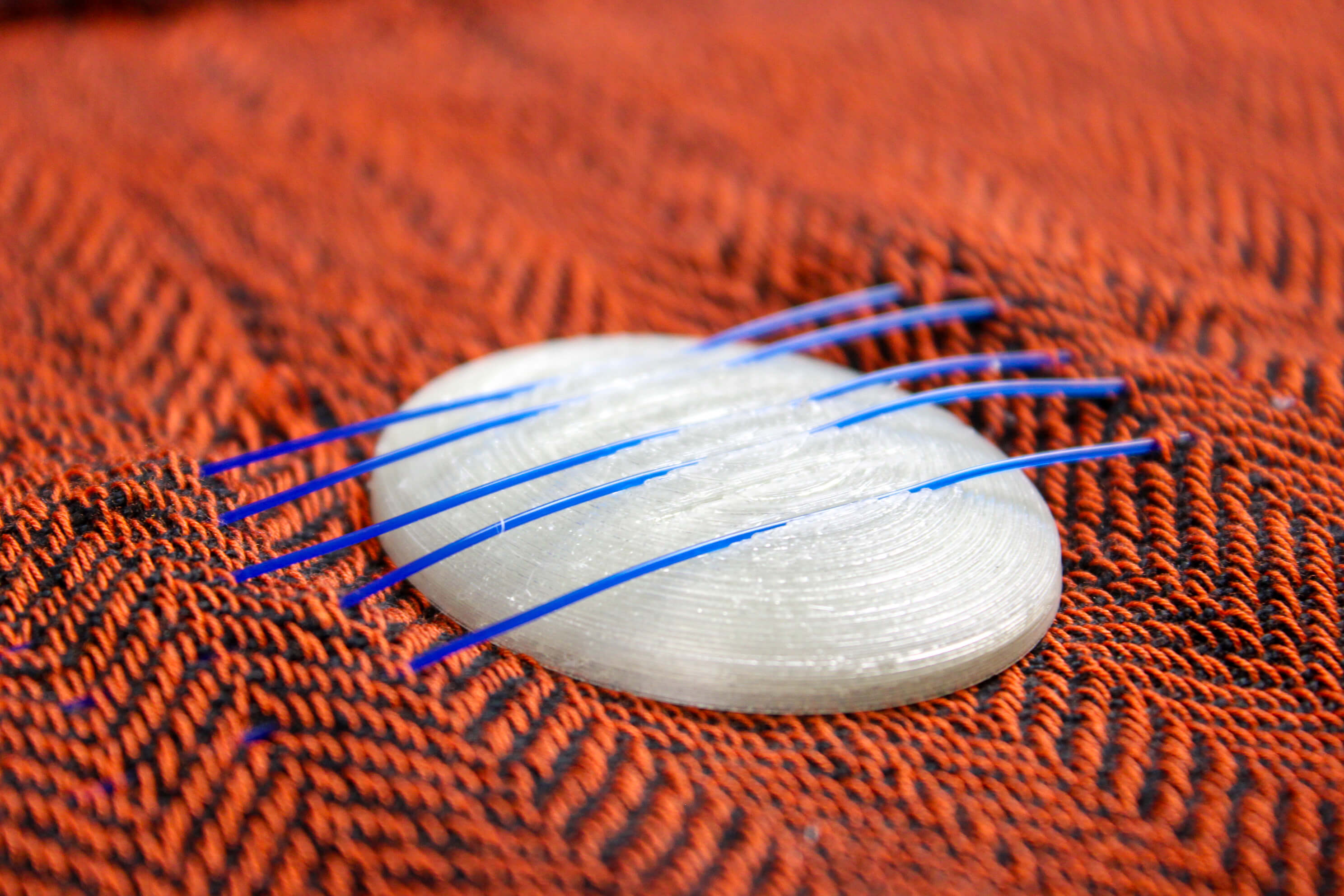
Different weaving patterns, wires and nylon filaments were tested to understand how vibration could travel through fabric. A flexible 0.8 mm nylon filament and raised woven floats provided the best balance between tactile feedback, comfort and wearability.
A wearable breathing experience
Final demonstrator
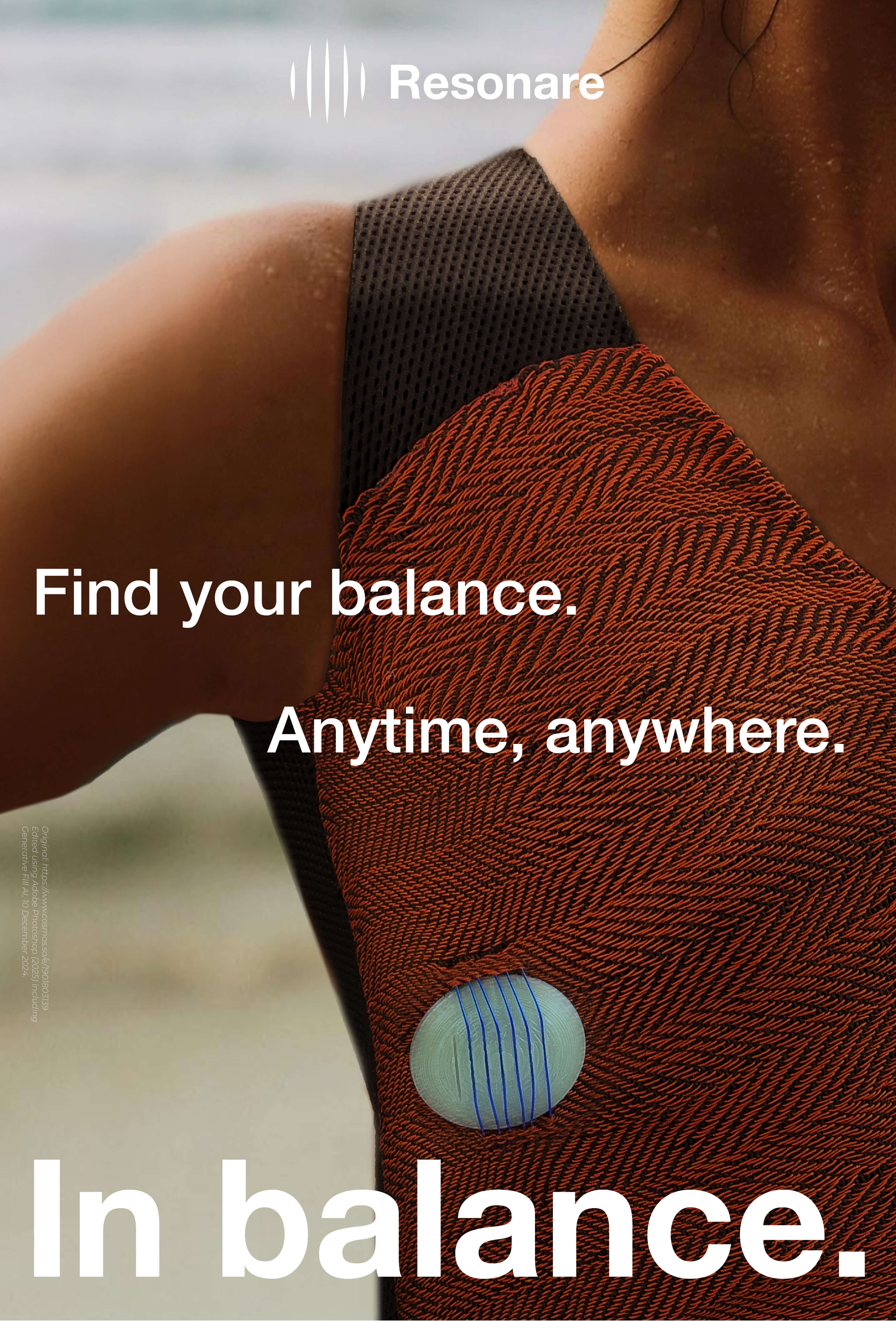
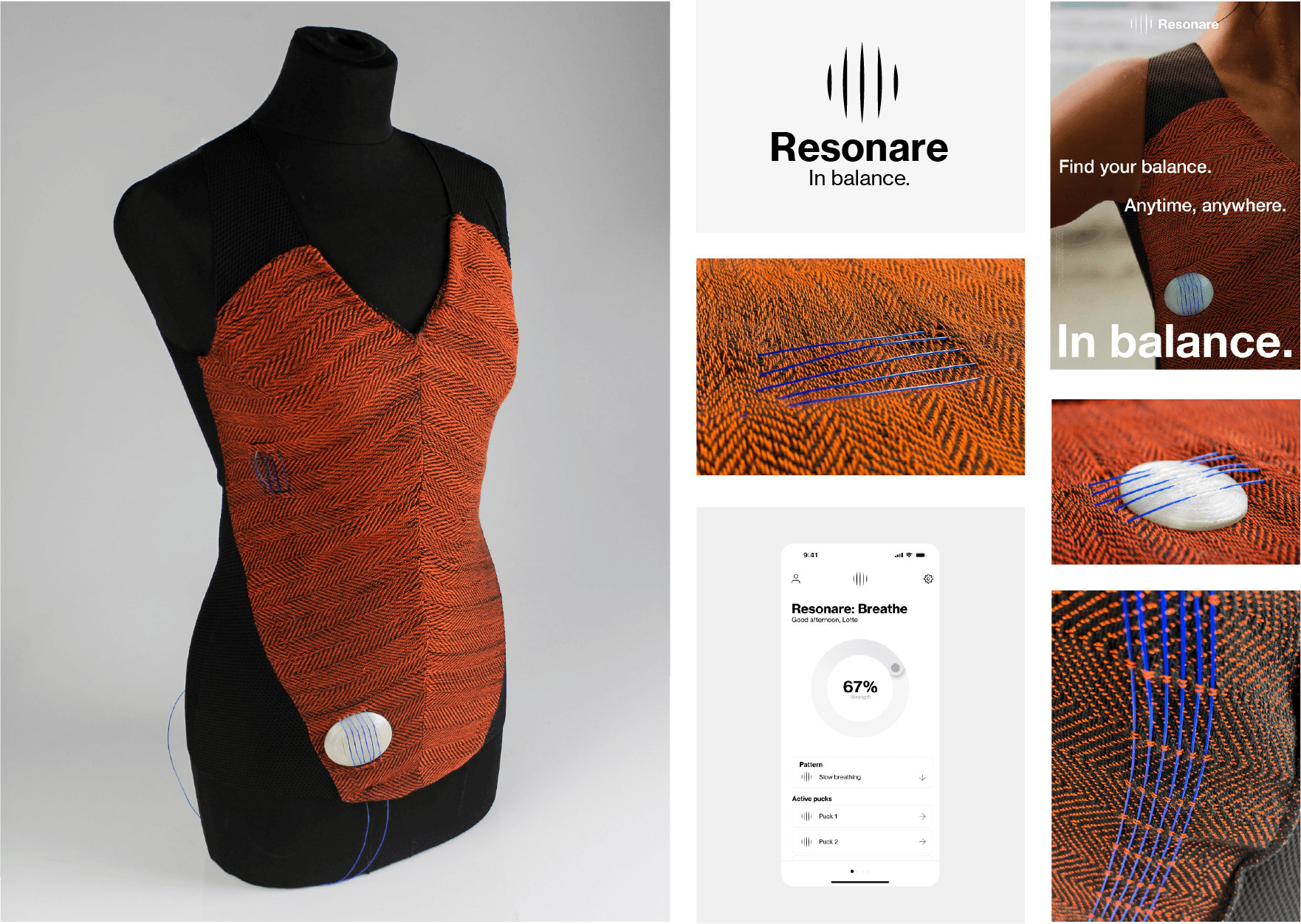
Resonare consists of a woven vest, three modular vibration pucks and an app.
The vibration sequence moves upwards during inhalation and gradually downwards during exhalation. User testing showed that upward movement felt intuitive for breathing in, while participants preferred slower, smoother and gentler feedback for breathing out. Testing also informed the placement of the modules, avoiding the less comfortable centre of the torso.
The final textile uses nylon threads to distribute vibration beyond the motors. Foam underneath the 3D-printed pucks reduces concentrated vibration, while the app allows users to adjust the intensity and breathing pattern.
The concept was positioned as a non-medical product centred on four values: calming, adaptive, innovative and empowering.
My contribution
I took a leading role during this project in the creative design process with a hands-on approach (ideating with quick prototypes and using first-person perspective to test lo-fi prototypes on my own body).
I contributed to the haptic experiments, electronics, soldering, textile exploration and development of the vibration-puck housing. I also carried out user tests and analysed qualitative and quantitative findings to translate participant experiences into design decisions.
In the final phase, I was primarily responsible for developing the concept further, which included the brand identity for Resonare, value proposition, competitor analysis and Business Model Canvas.
The project strengthened my ability to work through open-ended experimentation, combine first-person design with structured user testing and connect an experienceable prototype to a business proposition.